
This is a story about
what families lose —
and what we're building so they never lose it again.
VanshEra · Family Financial Continuity Intelligence · Pre-seed, ₹7 Cr · Confidential
The Search
When Rajesh's father passed, the family thought they knew what he had.
What they knew
- The house
- “Some FDs — SBI, probably”
- “An LIC policy… somewhere”
- One savings account
What they found — over 14 months
- 3 banks, one in another city
- 11 mutual-fund folios across 4 AMCs
- 2 insurance policies — one lapsed, unnoticed
- A bank locker nobody knew existed
- A personal loan quietly accruing interest
0 branch visits.
One stale nominee.
Rajesh is an IIT-educated product manager. His family is financially literate, urban, connected. The system still defeated them — because no system existed. Everything lived in his father's memory.
India runs on one person's memory — at national scale.
This money wasn't lost to fraud or markets. It was lost to silence between one generation and the next.
Sources: RBI Annual Report 2025-26 (DEA Fund, 31 Mar 2026); Ministry of Finance and Ministry of Labour replies to Parliament, Feb–Aug 2026 (restitution, UDGAM registrations, inoperative EPF); 1 Finance Magazine survey, n=1,218, 2026. Adding the figures each regulator publishes — bank deposits (₹1,12,564 Cr), insurance (₹8,974 Cr), inoperative EPF (₹9,331 Cr) and mutual funds (₹3,749 Cr) — gives approximately ₹1.35 lakh Cr. That is our aggregation of official components, not a published government total.
The Great Change
While families like Rajesh's searched, something enormous happened to Indian money.
Indian wealth became digital, fragmented, and enormous.
Sources: AMFI AUM and folio data, June 2026; SEBI Investor Survey 2025 (91,950-household listing survey); Goldman Sachs Research, “The rise of Affluent India”, Feb 2024 — affluent defined as individuals earning over $10,000 a year.
Here is the paradox that creates this company: every layer of Indian finance modernised — earning, investing, insuring, borrowing. Except the layer that decides whether a family can continue any of it.
The family with a drawer
- Knowledge in one head; papers in many places
- Discovery by archaeology: inboxes, lockers, guesses
- Months of branches, affidavits, photocopies
- Assets join the ₹1.13 lakh Cr
The family with a map
- Everything owned and owed — mapped, current, verified
- Risks fixed while the owner is alive and well
- The right information reaches the right person, verified
- Claims guided institution-by-institution
Every Indian family will end up in one of these columns. The product that decides which is the one we're building.
The Gap
Rajesh looked for a product that would have saved his family those 14 months. Here is what he found.
Everyone built shelves. Nobody checks readiness.
| The question a family needs answered | Aggregators | Will apps | Vaults & will apps (Yellow, WillJini, iWills) | VanshEra |
|---|---|---|---|---|
| What do we own today? | ✓ | — | if typed in | ✓ AutoMap, multi-rail |
| What do we owe — and is it covered on death? | — | — | — | ✓ 15 liability types + cover status |
| Do records match intentions? | — | — | — | ✓ nominee-vs-intention audit |
| What could go wrong, right now? | — | — | checklists | ✓ Family Risk Engine |
| What does my family DO on the day? | — | partially | documents only | ✓ verified release + Claims Navigator |
Live competitors are real — and they price the wrong thing. Yellow, the funded leader (Gruhas, IIFL Wealth/360 ONE, Kunal Shah, Nikhil Kamath), reports 20,000+ users but only 4,000+ wills created, on ₹50.5 lakh of FY25 revenue (MCA filings). Across the category — Yellow, WillJini, iWills — pricing is ₹2,499–₹19,999 one-time for a document. Almost nobody sells the living map, and nobody sells continuity as a subscription. Their existence proves the demand; their pricing proves the gap.
What Rajesh Needed
So we built it. This chapter is Rajesh's next ten years — with VanshEra.
Minute 0–15 · AutoMap
Rajesh links accounts via AA, imports CAS, adds property and the locker. 20 asset classes, 15 liability types — one Family Financial Map.
Day 1 · Risk Engine
Six findings: a stale nominee, an uncovered personal loan, a lapsing policy, a missing property paper, an unverified contact, no emergency card.
Month 1 · Continuity Plan
He fixes each one. His wife joins the vault. Trusted circle set: 2-of-3 quorum. Readiness score: 71 → 94.
Someday · Claims Navigator
Verified release — quorum + certificate + 21-day challenge window — then step-by-step claims for every institution. 14 months becomes 14 days.
Aggregators answer “what do I own?” Wills answer “who gets it?” Vaults answer “where is it?” VanshEra answers: is my family actually ready to continue without me?
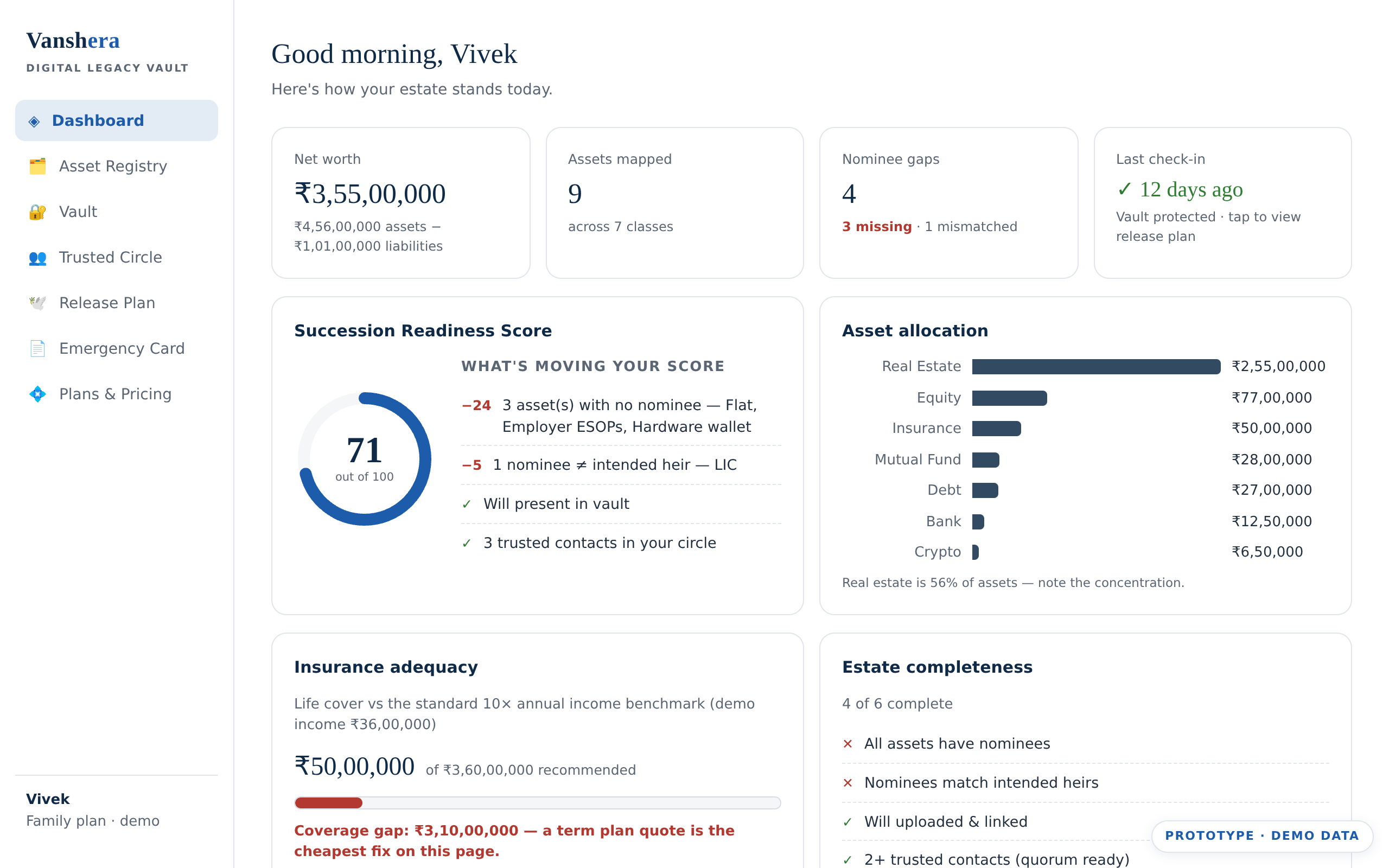
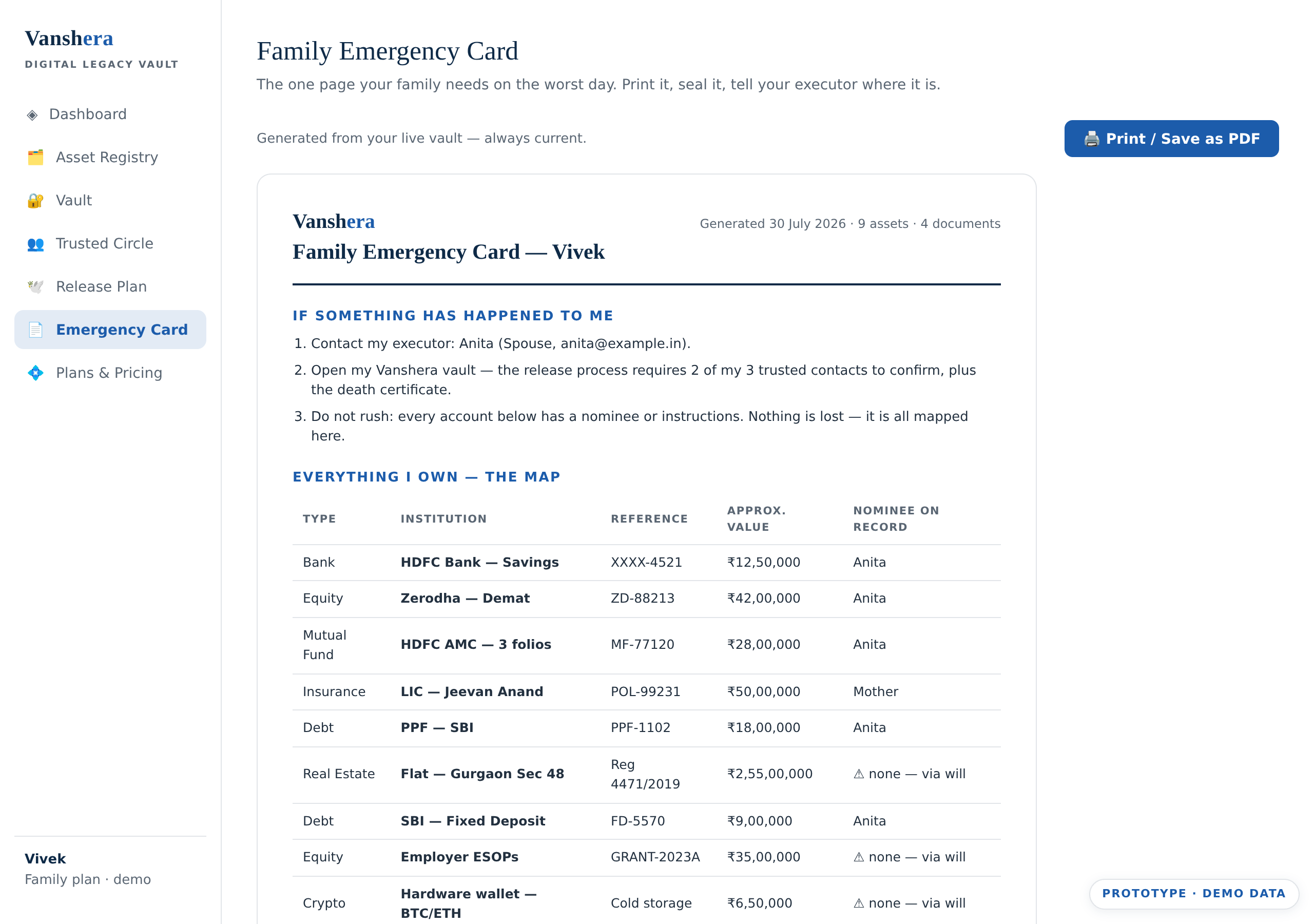
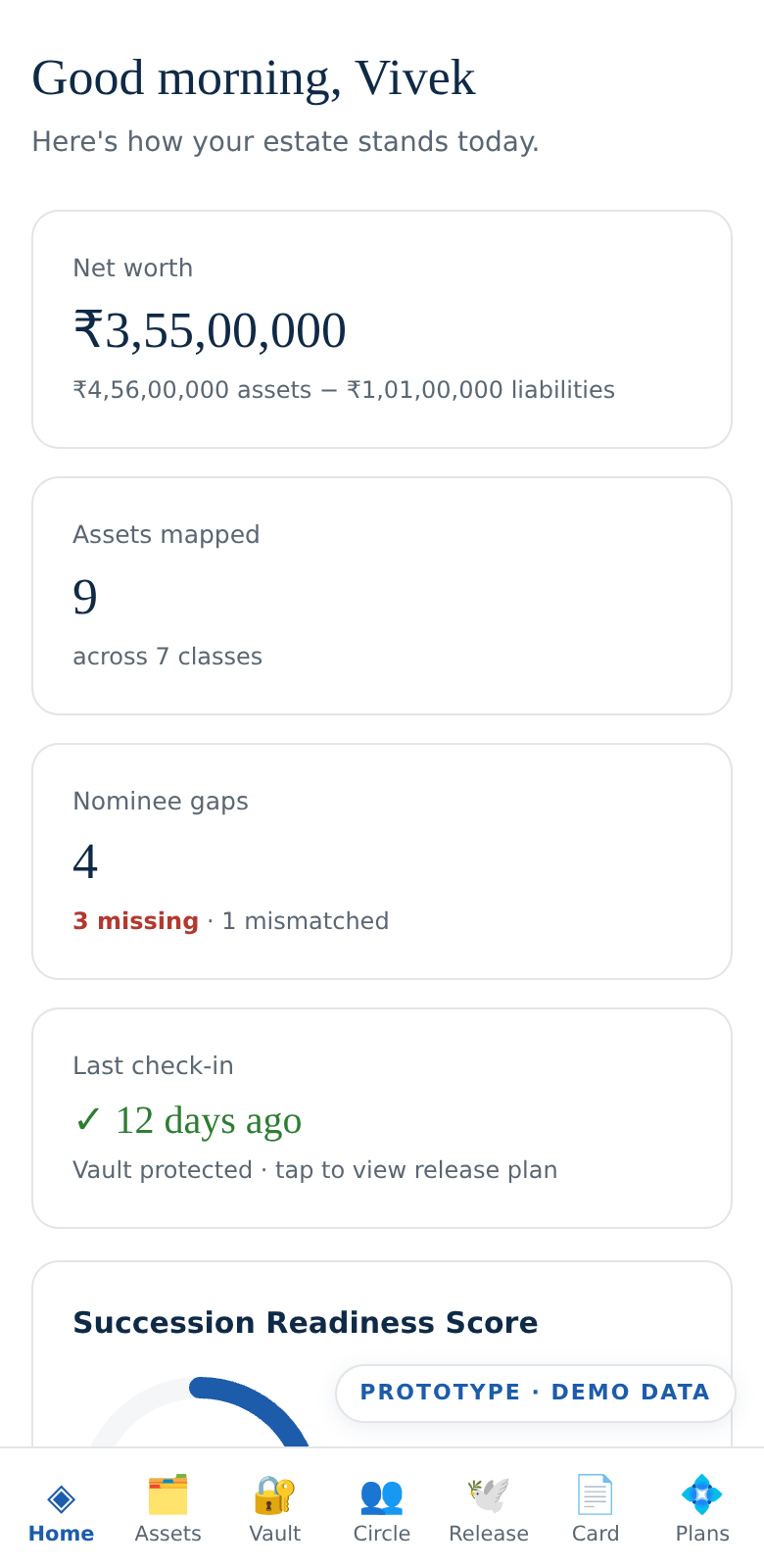
Four surfaces live — web (production auth + DB), Android, iOS, site — built solo, pre-funding. The readiness score, nominee-gap audit and Family Emergency Card exist today. Open the live app → · vanshera.com →
“Every family has one. The drawer.” · Companion reel: Do You Actually Know?
The Business of Continuity
How many Rajeshes are there — and what will each one be worth?
3.21 Cr securities-investing households × ₹2,800 blended ARPU — the category ceiling, not our buyer list
8–10M mass-affluent households (₹1–10 Cr net worth) × ₹3,200 blended ARPU — who we actually sell to
1 lakh paying households × ₹2,800 — about 1% of SAM in five years
2.5 lakh paying households
We refuse to claim all of India. Every layer above shows its own arithmetic. TAM is the ceiling if the category matures to every securities-investing household; we underwrite to SAM — the 8–10M households with enough complexity to pay.
And SEBI undercounts us: a household with property, EPF, FDs and a home loan needs continuity without owning a single share.
Above the floor: 1M free vaults by FY29 (funnel plan), Estate+ services, and B2B2C licensing to banks, AMCs and insurers.
Subscription first. Prepaid cash compounds it.
Individual ₹2,000/yr · Family ₹5,000/yr
Map, risk engine, vault, release plan; Family adds quorum + next-generation onboarding — every nominee is a future user.
5-Year Life Cover — age-priced
Pay 5 years, covered to 75 (₹9,309/yr at age 30). Collects ~₹23k at signup: with 25% mix, two-year operating cash burn falls to ~₹1.5 Cr.
Estate+ · B2B2C
Wills, succession docs, claims help via partner professionals (avg ₹15k). Later: the continuity layer white-labelled to institutions.
Product-led funnel — 65%
The free 2-minute readiness check + free vault. 50k free users FY27 → 1M FY29 at ~4% paid conversion (Stable Money's free-to-transaction rate: ~2.5%).
Story-led brand
The Drawer, the Family Financial Drill (#UGC), the Group Chat series — NISM-grain content in a high-emotion, empty space.
Trusted people — 35%
CAs, MFDs and RIAs convert cheapest (₹900) and carry authority. Then employers and financial institutions.
Proof thresholds before the seed round — stated as targets, not claims: 100–300 activated beta households · >60% mapping 3+ classes · >30% acting on a risk finding in 30 days · 10–20% paid conversion · 5–10 advisor pilots · zero security incidents.
The Plan
What ₹7 crore buys — and what exists at month 24.
₹7 Cr to prove Family Financial Continuity is a category.
Product moat — ₹2.6 Cr
Multi-rail AutoMap with provenance, Risk Engine, Claims Navigator. Team of 6 by FY28.
Trust moat — ₹0.8 Cr
Production security, VAPT, ISO 27001 path, DPDP governance, release controls.
Distribution moat — ₹2.4 Cr
Funnel to 250k free users, advisor network, first employer/FI pilots.
Regulatory moat — ₹1.2 Cr
AA/FIU written structure, CAS fallback, legal opinions, working capital.
| Terms | Month-24 outcomes | |
|---|---|---|
| Instrument | CCPS / iSAFE (₹32 Cr cap) | 2,000+ paying households · 250k free vaults |
| Founder — Vivek Goyal | retains 80% · shipped 4 surfaces solo, pre-funding · leaving ₹60L/yr career at a 60% cut | Repeatable paid + advisor acquisition proven · Risk-Engine action rate measured → seed-ready |
Rajesh's daughter is nine.
When it's her turn to ask what her father built —
she'll already know.
VanshEra — your family's financial backup plan.